Tuesday, June 4, 2024

LaCroix's "Interbellum Constitution"

Alison L. LaCroix, University of Chicago Law School, has published The Interbellum Constitution: Union, Commerce, and Slavery in the Age of Federalisms in the Yale Law Library Series in Legal History and Reference at the Yale University Press:

Between 1815 and 1861, American constitutional law and politics underwent a profound transformation. These decades of the Interbellum Constitution were a foundational period of both constitutional crisis and creativity.
 
The Interbellum Constitution was a set of widely shared legal and political principles, combined with a thoroughgoing commitment to investing those principles with meaning through debate. Each of these shared principles—commerce, concurrent power, and jurisdictional multiplicity—concerned what we now call “federalism,” meaning that they pertain to the relationships among multiple levels of government with varying degrees of autonomy. Alison L. LaCroix argues, however, that there existed many more federalisms in the early nineteenth century than today’s constitutional debates admit.
 
As LaCroix shows, this was a period of intense rethinking of the very basis of the U.S. national model—a problem debated everywhere, from newspapers and statehouses to local pubs and pulpits, ultimately leading both to civil war and to a new, more unified constitutional vision. This book is the first that synthesizes the legal, political, and social history of the early nineteenth century to show how deeply these constitutional questions dominated the discourse of the time.
Here are some endorsements:

The Interbellum Constitution reminds us of the important insights that have helped transform the historiography of the early American Republic, of slavery, and of relations between European settlers and Indigenous Peoples. . . . By mining the archive for information, [LaCroix] expands our understanding of the range of ideas about union, federalism, and sovereignty.”—Annette Gordon Reed, University of Chicago Law Review

“No scholar is better equipped to challenge our understanding of the history of federalism than Alison LaCroix. In this pioneering study, she recovers the spirited, contingent, decades-long argument that shaped an era that most constitutional historians have dismissed as uneventful. Essential reading.”—Jill Lepore, author of These Truths: A History of the United States

“Alison LaCroix’s invaluable book is a fount of information and brilliant insights about a grievously neglected period of American constitutional development. It is often gripping in the stories it relates. This is truly essential reading.”—Sanford Levinson, author of An Argument Open to All: Reading The Federalist in the 21st Century

“A brilliant, alternately rollicking and harrowing account of the law in action in the nineteenth-century United States. Prodigiously researched and bristling with startling revisionist arguments, this book is far and away the best account of the roiling world of American federalism in the crucial decades between the War of 1812 and the Civil War. The Interbellum Constitution carries urgent lessons for the emerging federal-state battles of our times.”—John Fabian Witt, author of American Contagions: Epidemics and the Law from Smallpox to COVID

Professor LaCroix discusses her book in a virtual session sponsored by the Supreme Court Historical Society.

--Dan Ernst

Monday, June 3, 2024

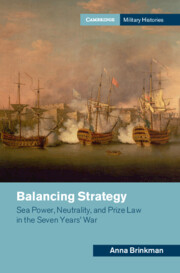
Brinkman on "Sea Power, Neutrality, and Prize Law in the Seven Years' War"

Cambridge University Press has published Balancing Strategy: Sea Power, Neutrality, and Prize Law in the Seven Years' War (2024), by Anna Brinkman (King's College London). A description from the press:


What is the relationship between seapower, law, and strategy? Anna Brinkman uses in-depth analysis of cases brought before the Court of Prize Appeal during the Seven Years' War to explore how Britain worked to shape maritime international law to its strategic advantage. Within the court, government officials and naval and legal minds came together to shape legal decisions from the perspectives of both legal philosophy and maritime strategic aims. As a result, neutrality and the negotiation of rights became critical to maritime warfare. Balancing Strategy unpicks a complex web of competing priorities: deals struck with the Dutch Republic and Spain; imperial rivalry; mercantilism; colonial trade; and the relationships between metropoles and colonies, trade, and the navy. Ultimately, influencing and shaping international law of the sea allows a nation to create the norms and rules that constrain or enable the use of seapower during war.

Praise from reviewers:

'This is imperial, military, legal and maritime history at its scrupulous and creative best, at once both micro- and macro-historical. Through a detailed reconstruction of four cases coming before Britain's Court of Prize Appeal and concerning two Dutch and two Spanish vessels captured during the Seven Years War, Anna Brinkman convincingly reveals for the first time the overarching strategic role that the court played in balancing domestic and international law to keep the Dutch Republic and Spain neutral during the global conflict. Particularly nuanced - and wholly unique in prize history - is her attention to the human dimension of legal process: the myriad of people, personalities, ties, interests, and environments that destabilized or undergirded neutrality. A triumph of insight and scholarship.' -- David Hancock

'Balancing Strategy opens a window into the complex interplay of law, empire, seapower, and strategy. Through meticulous and well-documented case studies that incorporate legal records, private political accounts, and the popular press, Brinkman offers new insight into how Britain sought legitimacy for its increasing projection of power on the global stage.' -- Sarah Kinkel

An interview with Brinkman is available here, at New Books Network.

-- Karen Tani

Saturday, June 1, 2024

Weekend Roundup


  • Thomas G. Corcoran, 1935 (LC)
    A side note to the forgoing: At the start of his post, Dr. Reft reproduces a letter from Edward Holmes, the justice's nephew and executor, to Tom Corcoran, the justice's favorite legal secretary, in which the executor refers to "a question that intervenes between us."  Perhaps the question was the disposition of the Black Book.  In his often reliable memoir, Corcoran claimed that on the night the justice died, Edward Holmes said that the Black Book was "too personal" and should be destroyed, but that when the nephew's back was turned he "slipped it behind some other volumes on a shelf.  A little later I smuggled it out of the house under my shirt and sent it by courier the next day to the Harvard Law School."  Thomas G. Corcoran with Philip Kopper, “Rendezvous with Democracy: The Memoirs of ‘Tommy the Cork,’” Holmes, pp. 39-40, box 586, Corcoran MSS, Library of Congress.  I've never looked for corroborating evidence in the Edward J. Holmes Collection or other HLS records.  DRE.

  • The Beinecke Rare Book and Manuscript Library at Yale University has issued a call for applications for its Fellowship Program. The library "welcome[s] applications from scholars and graduate students locally and globally who utilize traditional methods of archival and bibliographic research as well as from individuals who wish to pursue creative, interdisciplinary, and non-traditional approaches to conducting research in the collections." 
  • The New-York Historical Society has announced substantial postdoctoral and predoctoral fellowships in Women's History.  Due date: June 30
  • New on the Digging a Hole podcast: David C. Schleicher and Samuel Moyn interview Dylan C. Penningroth on his book Before the Movement: The Hidden History of Black Civil Rights.  And congratulations to Professor Penningroth for winning the J. Willard Hurst Book Prize of the Law and Society Association for Before the MovementBerkeley Law's notice of the awards the book has garnered is here.
  • On the New Books in Intellectual History podcast,  Kunal M. Parker discusses The Turn to Process: American Legal, Political, and Economic Thought, 1870-1970.
  • On the New Books in African American Studies podcast, Robert K. D. Colby discusses An Unholy Traffic: Slave Trading in the Civil War South.
  • ICYMI: Robert W. Gordon, Stanford Law, on the Trump Conviction and the History of Presidential Crimes (SLS Blogs).  The 1924 Indian Citizenship Act (Smithsonian; History Today).  Policy approaches to addressing a history of racial discrimination (Stanford IEPR).  Delaware marks 70th anniversary of its role in landmark Brown v. Board decision (WHYY).
 Weekend Roundup is a weekly feature compiled by all the Legal History bloggers.

Friday, May 31, 2024

Frederick Douglass and the Two Constitutions

Frederick Douglass (NYPL)
We recently noticed that the papers resulting from "Frederick Douglass and the Two Constitutions: Proslavery and Antislavery," the Thomas M. Jorde Symposium for 2022, have been published in the California Law ReviewHere is a recording of the symposium, and here are the papers:

Frederick Douglass and the Two Constitutions: Proslavery and Antislavery
David Blight

Comment on Frederick Douglass and the Two Constitutions: Proslavery and Antislavery
Annette Gordon-Reed

"A Fixed Principle of Honesty": Frederick Douglass, False Certainties, and Words without Memory
Christopher Tomlins

Response to Professor Blight's Frederick Douglass and the Two Constitutions: Proslavery and Antislavery

Martha S. Jones

Frederick Douglass's Constitution
James Oakes

--Dan Ernst

Thursday, May 30, 2024

The Docket 7:1-2

Now online: issues 7:1-2 of The Docket, the online partner of Law and History Review:

Gautham Rao, Big Changes at Law and History Review

Barbara Lauriat, Robinson & Roberts v. Wheble (1771): A New “First” Trademark Case at Common Law

Lawrence Goldstone, Unreliable Narrator: The Federalist Essays

Bruce W. Dearstyne, A Judge and Presidential Candidate Searches for the Meaning of Due Process

Sohum Pal reviews Aziz Rana, The Constitutional Bind

Cameron Sauers reviews Giuliana Perrone, Nothing More Than Freedom

--Dan Ernst

Morgan on "Women, Violence and the Law – A Hidden History"

Mudlark press has published The Walnut Tree: Women, Violence and the Law – A Hidden History, by Kate Morgan (2024). A description from the press:

'A woman, a dog and a walnut tree, the more they are beaten, the better they’ll be.'

So went the proverb quoted by a prominent MP in the Houses of Parliament in 1853. His words – intended ironically in a debate about a rise in attacks on women – summed up the prevailing attitude of the day, in which violence against women was waved away as a part and parcel of modern living – a chilling seam of misogyny that had polluted both parliament and the law. But were things about to change?

In this vivid and essential work of historical non-fiction, Kate Morgan explores the legal campaigns, test cases and individual injustices of the Victorian and Edwardian eras which fundamentally re-shaped the status of women under British law. These are seen through the untold stories of women whose cases became cornerstones of our modern legal system and shine a light on the historical inequalities of the law.

We hear of the uniquely abusive marriage which culminated in the dramatic story of the ‘Clitheroe wife abduction’; of the domestic tragedies which changed the law on domestic violence; the controversies surrounding the Contagious Diseases Act and the women who campaigned to abolish it; and the real courtroom stories behind notorious murder cases such as the ‘Camden Town Murder’.

Exploring the 19th- and early 20th Century legal history that influenced the modern-day stances on issues such as domestic abuse, sexual violence and divorce, The Walnut Tree lifts the lid on the shocking history of women under British law – and what it means for women today.

An interview with Morgan is available here, at New Books Network. 

-- Karen Tani

Wednesday, May 29, 2024

Sachs on Good, Evil, and the American Founding

Stephen E. Sachs, Harvard Law School, has posted Good and Evil in the American Founding: The 2023 Vaughan Lecture on America's Founding Principles, which is forthcoming in the Harvard Journal of Law and Public Policy:

The past few decades have seen a broad moral reevaluation of the American Founding. Both on the left and on the right, many now regard the Founders’ ideals as less valuable and their failings as more salient. These reckonings are necessary, but they also risk missing something important: a richer and more human understanding of the past, together with a recognition of the great good that the American Founding achieved, here and elsewhere. This Essay discusses how we ought to understand the Founders’ historical legacy—and why we might respect and indeed honor their contributions with open eyes.
--Dan Ernst

Tuesday, May 28, 2024

Ruskola on Montesquieu and "Oriental Despotism"

Teemu Ruskola, University of Pennsylvania Carey Law School, has posted Oriental Despotism Inside Out: On the Global Travels of Montesquieu’s De l’esprit des lois:

Baron de Montesquieu (NYPL)
This speculative essay analyzes Montesquieu’s comparative method in his De l’esprit des lois (1748) and its contemporary legacies. It takes as its focus his theory of Oriental despotism. The first half of the paper focuses on two aspects of his method. First, Montesquieu’s empirical approach to political theory marks him apart from his humanist predecessors. Turning away from natural law and a search for universal principles, he instead attends to nature itself in order to understand the diversity of social and legal phenomena. Second, I comment briefly on Montesquieu’s reworking of Europe’s metageographic status. I analyze him as a key figure in replacing an essentially religious distinction between the Christian world and a heathen Orient with a more plural world divided into continents marked by cultural and political differences.

In the second half of the paper I turn to Montesquieu’s use of China as a paradigmatic instance of “Oriental despotism.” Paradoxically, Montesquieu develops his idea of despotism as a critique of French absolutism while projecting its prototype into the Orient, China in particular. In the final analysis, however, Montesquieu himself is forced to admit that in several key respects China does not fit the category it supposedly exemplifies. Yet despite its flawed empirical foundation, over time Oriental despotism mutates from a theory of politics into a theory of scientific racism with global implications. I conclude by examining the geopolitical implications of Montesquieu’s analysis with respect to the discourse of Chinese authoritarianism today.
--Dan Ernst

Monday, May 27, 2024

LHR 42:2

Law and History Review 42:2 (May 2024) is now available online:

Legal Pluralism as a Category of Analysis
Jessica Marglin, Mark Letteney

Legal Pluralism's Other: Mythologizing Modern Law
Caroline Humfress

Legal Pluralism from History to Theory and Back: Otto von Gierke, Santi Romano, and Francesco Calasso on Medieval Institution
s
Emanuele Conte

The Rise of the Indigenous Jurists
Clifford Ando

Interpolity Law and Jurisdictional Politics
Lauren Benton, Adam Clulow

The Uses and Abuses of Legal Pluralism: A View from the Sideline
Tamar Herzog

Rethinking the Rethinking of Legal Pluralism: Toward a Manifesto for a Pluri-Legal Perspective
Ido Shahar, Karin Carmit Yefet

The Edicts of the Praetors: Law, Time, and Revolution in Ancient Rome
Lisa Pilar Eberle

The Carried-Off and the Constitution: How British Harboring of Fugitives from American Slavery Led to the Constitution of 1787
    Timothy Messer-Kruse

Free Black Witnesses in the Antebellum Upper South
Eric Eisner

Disobedient Children, Hybrid Filiality: Negotiating Parent–Child Relations in Local Legal System in Republican China, 1911–1949
Shumeng Han, Xiangyi Ren

Human Rights at the Edges of Late Imperial Britain: The Tyrer Case and Judicial Corporal Punishment from the Isle of Man to Montserrat, 1972–1990
Christopher Hilliard, Marco Duranti

An Instrument of Military Power: The Development and Evolution of Japanese Martial Law in Occupied Territories, 1894–1945
Kelly Maddox

“Above the Written Law”: Iran-Contra and the Mirage of the Rule of Law
Alan McPherson

--Dan Ernst

Sunday, May 26, 2024

Sunday Roundup

  • The Dallas Bar Association will sponsor. with the J.L. Turner Legal Association, a conversation with Jose F. Anderson, University of Baltimore School of Law, on his book Genius for Justice: Charles Hamilton Houston and the Reform of American Law on Thursday, May 30, 2024, 12:00 PM to 1:00 PM, at Dallas’s Arts District Mansion.  Professor Anderson will highlight “cases litigated from Texas that were part of Houston's strategy to define the responsibility and privileges of citizenship under constitutional government.”  CLE credit is available.
  • We've previously noted the passing of Stephen J. PollakHere are Attorney General Merrick Garland's remarks at a memorial event for Mr. Pollak.

--Dan Ernst

Saturday, May 25, 2024

Weekend Roundup

  • Over at Balkinization, an interesting symposium on David Pozen's The Constitution of the War on Drugs (Oxford University Press, 2024) has wrapped up. This response by Pozen (Columbia Law) links to the various contributions, including by legal historian Shaun Ossei-Owusu (Penn Law).
  • Edward A. Purcell, New York Law School, looks back to Charles Evans Hughes's Supreme Court of the United States for inspiration on how Chief Justices can induce the resignations of Associate Justices  (The Hill).
  • Jus Gentium is out with a special issue (9:2), The Historicization of International Law and its Limits, organized by Jean d’Aspremont and Thomas Kleinlein.  It includes the article “Lather, Rinse, Repeat: The Historical Returns of International Law,” by Carl Landauer.
  • “On May 16, in celebration of the 70th anniversary of the Supreme Court Brown v. Board of Education decision, the National Archives in Washington, DC, hosted a panel discussion on the lasting impact of the historic legal decision.”  The panel included Sheryll D. Cashin, Georgetown Law; Randall L. Kennedy, of Harvard Law School; and Michael K. Powell, who moderated.  More.
  • Also, “Meet all the families behind the 5 school cases that swayed the Supreme Court” (LA School Report).
  • “Dr. John Kirk, George W. Donaghey Distinguished Professor of History at UA Little Rock, and the students in his fall 2023 Seminar in Public History class, a capstone course that focuses on collaborative research for students who are earning a Master of Arts in public history, have received the Lucille Westbrook Award from the Arkansas Historical Association” for the paper “Racial Discrimination in Jury Selection: The Arkansas Cases of the Bone Brothers, 1938-1940.”  More.
  • The program for the 2024 annual meeting of the American Political Science Association is now online.
  • ICYMI: Hardeep Dhillon on The Immigration Act of 1924 (Penn Today). "The 'Originalist' Justices Keep Getting History Spectacularly Wrong" (Balls & Strikes).  That "Appeal to Heaven" flag (AP; MSNBC).
 Weekend Roundup is a weekly feature compiled by all the Legal History bloggers.

Friday, May 24, 2024

A 17th-Century Grand Jury Exhortation

Just out, open access, in Law and History Review: A Grand Jury Exhortation, edited and introduced by Benjamin Keener, a JD candidate at Penn Law:

This essay brings to light a rare feature of the Stewart legal system. Grand jury charges remain understudied, partly for want of primary source materials. The brief historical and biographical sketches of the essay are appended by a unique and relevant artifact of the time: a preamble or exhortation to a grand jury charge, ostensibly delivered by a Justice of the King's Bench, John Dodderidge.

--Dan Ernst

Thursday, May 23, 2024

Lessard and Plante on Animals and the Law in Québec

Let the Wild Rumpus Start! Michaël Lessard and Marie-Andrée Plante, Université de Sherbrooke, have posted Where the Wild Things Are (and Have Been): An Archeology of Legal Discourses on Animals in Québec, which is forthcoming in the Alberta Law Review:

Are animals mere things in the eyes of the law? Public discourse suggests so. However, the history of legal discourses about animals reveals another story. For better or for worse, animals have not been considered as mere things in law. It was long recognized that animals possess certain characteristics that are observable in beings, such as agency, sentience, and sociability. Together, agency, sentience, and sociability constitute a cluster of being-like characteristics sketching, through time, a portrait of the animal that is distanced from the image of a mere object of property. To support this conclusion, we ask where the “wild things” are and have been in our legal history. We relocate animals in the history of legal discourses surrounding them in the territory of Québec, beginning slightly before codification. As many individuals worldwide would like to see their own jurisdiction explicitly recognize that animals are not things but beings, Québec provides a fruitful case study for international readers on the impact that such a change may have on legal norms and discourses.
--Dan Ernst

Tuesday, May 21, 2024

Reminder of upcoming (June 1) ASLH deadlines

 Via the leadership of the American Society for Legal History, we have the following reminder:

A reminder that June 1, 2024 is the deadline for applying for many ASLH prizes and fellowships. 

Early Career scholars and graduate students can apply for the Student Research Colloquium and the Cromwell Fellowships. Recent PhDs in European legal history in a Global Perspective should consider applying for our new opportunity for residence at the Max Planck Institute. Early career scholars can also apply to the Virtual Early Career Workshop, applications for which are due June 30.

Each year the ASLH also sponsors a rich array of book and article prizes, including a prize in digital legal history.

Finally, a reminder that each year the ASLH makes available grants of up to $5,000 for Projects and Proposals related to legal history. These applications will be due September 15, 2024.

You might also use this opportunity to renew your membership!

-- Karen Tani

Priel on the Legal Realists on Political Economy

Dan Priel, York University Osgoode Hall Law School, has posted The Legal Realists on Political Economy, which is forthcoming in Law and Social Inquiry:

Thurman Arnold (LC)
Alongside the well-known jurisprudential ideas associated with legal realism, some scholars have highlighted the realists’ political-economic ideas. Best known among them has been Morton Horwitz, who has argued that the realists launched an “attack on the legitimacy of the market.” Other scholars challenged this view and argued there was no significant connection between legal realism and political economic ideas. I offer a corrective to both views. I first consider the work of five legal realists (Karl Llewellyn, Adolf Berle, William O. Douglas, Jerome Frank, and Thurman Arnold) and show that all held views that were well within the political-economic mainstream of their era, which did not challenge the legitimacy of market capitalism but wanted to see them better regulated. For many of them, there were important connections between their jurisprudential and political-economic ideas. I then turn to some neglected writings of Felix Cohen, to show that he too saw a direct link between his legal and economic ideas. However, unlike the other legal realists discussed here, he was a radical critic of market capitalism. I use his political-economic writings for a reconsideration of his better known jurisprudential works.
--Dan Ernst

Monday, May 20, 2024

Fitzgerald's "Sir Gerard Brennan" (and Clune's Review Thereof)

Jeffrey Fitzgerald has published  Sir Gerard Brennan: The Law's Good Servant (2024):

This is the first comprehensive biography of Sir Gerard Brennan, who is best known for his judgment in the Mabo case. It highlights the significant role Brennan played in the development of Australian law and in society more broadly. It traces his family background and life, education, and early career in Queensland before turning to the roles for which he is best known – inaugural president of the [Administrative Appeals Tribunal], judge of the Federal Court and High Court, and finally, Chief Justice of Australia. It provides detailed analysis of Brennan’s most significant judgments and compares his reasoning with that of other members of the court. In so doing, it provides valuable insight into his judicial methodology. The book explores how Brennan dealt with the sometimes competing demands of the strict application of legal precedent, and of the need to do justice in a changing social context.

The book also considers the way he sought to balance the compelling demands of his judicial duties and those he saw inherent in both his family responsibilities and his Catholic faith. The portrait which emerges does justice to Brennan the man, as well as Brennan the judge.

As Registrar at [University of Technology Sydney], the author worked closely with Brennan during the period he was Chancellor. He interviewed Brennan extensively, was given access to personal documents, and interviewed more than sixty of Brennan’s colleagues, associates, family members and friends. The resulting book is an important historical record of the life and times of a great Australian and will give readers a deeper understanding of the inner dynamics of the Australian court system.

William H. Clune, University of Wisconsin Law School, has posted a review in the guise of an interview of Fitzgerald:

This is a book review in interview format with me interviewing the book’s author, Jeffrey Fitzgerald. The book is a judicial biography of the famous and influential Australian jurist, Sir Gerard Brennan. Largely in chronological sequence, the book also identifies cross-cutting themes such as the evolution of his jurisprudence over time.

My questions are designed to highlight issues that have parallels in American law, thus introducing the book to American readers. A second focus is the interaction of law and society. Law and society issues pervade the book because it is a longitudinal account of the judge’s encounters with important legal issues that arose in a changing Australian society, his influence on that society, and the corresponding evolution of his jurisprudence. It is law as both a dependent and independent variable, a classic law and society formulation. The judge’s decisions and jurisprudence operate as “constitutive law,” reflecting both the influence of society on law and its influence on society while remaining relatively autonomous from both. Former U.S. Supreme Court Justice Steven Breyer’s recent exposition of judicial “pragmatism” is congruent with the jurisprudence of Justice Brennan.

The paper has eight parts with questions and answers as sub-parts: (1) the book and Brennan’s career; (2) constitutional law, federalism, separation of powers, judicial review; (3) civil rights, aboriginal people’s rights, racial discrimination, and other rights; (4) impact on other areas of law (e.g., torts, contracts, criminal law); (5) Brennan’s principles of jurisprudence (6) the High Court, its divisions, and politics (7) personal, family, and professional life; (8) conclusion: mutual influence of law and society.

--Dan Ernst

Sunday, May 19, 2024

Sunday Roundup

Some items arrived too late for our usual Weekend Roundup.

  • Boston University Law's appreciation of (fellow Dubuquer) David Seipp as he goes emeritus.
  • My Georgetown Law colleague Adam Levitin on the majority opinion in CFPB v. CFSA: "Supreme Court Justices aren't just historians, and when they foray into English constitutional history, in particular, they are in real danger of getting out over their skis" (Credit Slips).
  • That AI-generated "recording" of the argument in Brown. Laurence Tribe says that Chief Justice Warren's voice was more gravelly.  Also, Kenneth W. Mack talks to Jill Lepore on the 70th anniversary of Brown (The Last Archive).
  • ICYMI: Talking to high school juniors about the history of the First Amendment (Williamsport Sun-Gazette).  The Day after Brown (NPS).  The Washington Supreme Court overturns the conviction of Jim Wallahee, wrongly prosecuted for hunting deer on traditional Yakama tribal grounds in 1924 (Chronicle).

--Dan Ernst

Saturday, May 18, 2024

Weekend Roundup

  • Saul Cornell’s contribution to the Slate series, “How Originalism Ate the Law,” is Why the Right Dominates When It Comes to Legal “History.”  (His answer?  “They’re invested in legal education, creating an originalist industrial complex with outsize influence.”)  Also, Thomas Wolf explains the Brennan Center's efforts to mobilize historians to counter the Supreme Court's historical claims.
  • For Members of the American Society for Legal History:  A reminder that the ASLH  has announce "a new virtual initiative – the Early Career (Virtual) Legal History Workshop – designed to provide support and intellectual community to early career scholars working in legal history, broadly defined.  Applications are invited from early career, pre-tenure scholars, publishing in English, who have completed PhDs or JDs (those working toward a JD/PhD must have completed the PhD)."  Deadline for Applications: June 30, 2024More.
  • "History and the Law," a panel conversation "on important moments in American legal history, applying history education to the study and practice of the law, and more," presented as an introduction to the History Pre-Law Concentration at Villanova University (YouTube).
  • Ariela Gross, UCLA School of Law, will lecture on  “Erasing Slavery – How Stories of Slavery and Freedom (in Natchez) Shape Battles Over the Constitution” at the Tuesday, May 28 meeting of the Natchez Historical Society (Natchez Democrat).
  • LHB Founder Mary Dudziak, Emory Law, on the legacy of Korean War at the recent TCU Conference on the Korean War (YouTube).
  • More on that recent conference on the political history of the New Deal at Vanderbilt University.
  • Erika Rappaport, University of California, Santa Barbara, reviews The Rise of Mass Advertising, Law, Enchantment and the Cultural Boundaries of British Modernity, by Anat Rosenberg in the English Historical Review. Christopher Tomlins, Berkeley Law, reviews Joseph Fishkin and William E. Forbath’s The Anti-Oligarchy Constitution: Reconstructing the Economic Foundations of American Democracy in the Journal of Law and Political Economy.  And Ajay K. Mehrotra, Northwestern Law, reviews Andrew Koppelman's Burning Down the House: How Libertarian Philosophy Was Corrupted by Delusion and Greed, also in JLPE.

 Weekend Roundup is a weekly feature compiled by all the Legal History bloggers.

Friday, May 17, 2024

CFP: The Medieval Academy's Centenary

[We have the following Call for Papers.  DRE]

The Medieval Academy at 100: The 2025 Annual Meeting of the Medieval Academy of America.  Harvard University, Cambridge MA,  20-22 March 2025.

The Centennial Meeting of the Medieval Academy of America will take place on the campus of Harvard University in Cambridge, Massachusetts, hosted by Harvard University, Boston College, Boston University, Brandeis University, Fitchburg State University, the Massachusetts Institute of Technology, Stonehill College, Tufts University, and Wellesley College. While the conference will take place in person, the plenary lectures and some other events also will be live streamed. Plenary addresses will be delivered by Kristina Richardson (Professor of History and Middle Eastern and South Asian Languages and Cultures, University of Virginia), Sara Lipton (Incoming President of the Medieval Academy of America and Professor of History, Stony Brook University), and Wendy Belcher (Professor of Comparative Literature and African American Studies, Princeton University). The Annual Meeting will be followed by the Sunday annual meeting of the Medieval Academy's Committee on Centers and Regional Associations (CARA). [More.]

Thursday, May 16, 2024

JACH (Spring 2024)


The Spring 2024 issue of the Journal of American Constitutional History has now been published.

Ida B. Wells’s Train Ride in Memphis and the Dawn of Jim Crow
Lee Harris

Most Americans know the story of Rosa Parks; fewer know the story of Ida B. Wells, who contested the nascent Jim Crow laws on the Tennessee railways more than 70 years before Rosa Parks’ famous bus ride. This article profiles Wells’ journey from small-town schoolteacher, to legal challenger in the fight against racial segregation.

Racism, Black Voices, Emancipation, and Constitution-Making in Massachusetts, 1778
David Waldstreicher

Black voices—even disembodied, anonymous, speculative Black voices—were part of the constitutional conversation in Massachusetts in 1777-78. If that isn’t being present at the creation of the American republic, then terms like “founding” and “creation” lose most of their meaning.

The Democracy Effects of Legal Polarization: Movement Lawyering at the Dawn of the Unitary Executive
Deborah Pearlstein

In the 1980s, a conservative legal movement began to advance a unitary executive theory of constitutional power inside the Executive Branch; these efforts functioned to kneecap a suite of post-Watergate ethics reforms designed to guard against corruption or other misconduct by government lawyers, which, over time, has led to an increasingly polarized system in which career advancement, not punishment, awaits lawyers willing to place partisan loyalty above professional obligation. This serves as a troubling case study of the range of harms legal polarization poses to constitutional democracy inside court and out.

Executive Power, the Royal Prerogative, and the Founders’ Presidency
Andrew Kent
[Forthcoming.] 

--Dan Ernst


Wednesday, May 15, 2024

Craig's "English Administrative Law from 1550"

Paul Craig, Emeritus Professor of English Law, St. John's College, Oxford, has published English Administrative Law from 1550: Continuity and Change in the series Oxford Legal History:

The commonly held view about English administrative law is that it is of recent origin, with some dating it from the mid-20th century and some venturing back to the late 19th century. English Administrative Law from 1550: Continuity and Change upends this conventional thinking, charting its development from the mid-16th century with an in-depth examination of administrative law doctrine based on primary legal materials, statute, and case law.

This book is divided into four parts. Part I sets out the book's principal thesis, contrasting standard perceptions concerning the existence of English administrative law with the reality of its emergence from the mid-16th century. Part II is concerned with Regulation and Administration from the mid-16th century to the end of the 19th century. There is detailed analysis of the regulatory and administrative state, which includes chapters on the way in which administrative policy was developed through individual decision-making and rulemaking, and the role played by contract in service delivery. Part III deals with Courts and Doctrine. It begins with discussion of foundational precepts followed by chapters on natural justice; review of law and fact; rights; delegation, fettering and purpose; reasonableness; proportionability; prerogative; and third and fourth source power. Part IV of the book covers Remedies and Review, with chapters on invalidity; standing; the prerogative writs; injunction, declaration, quo warranto and habeas corpus; and damages and restitutionary liability.

With thought-provoking and original insights, English Administrative Law from 1550 systematically elaborates and contextualizes the origins of administrative law features while linking them to their modern-day equivalents.
–Dan Ernst

Tuesday, May 14, 2024

Alan Rodger Postgraduate Visiting Researcher at Glasgow

[Via H-Law, we have the following announcement.  DRE.]

The University of Glasgow School of Law invites applications from PhD students in Roman law/legal history for the post of Alan Rodger Postgraduate Visiting Researcher, to be held during the 2024/25 academic year. The selected candidate will spend a term in Glasgow and receive a £2,000 award for support. The deadline for applications is 28 June 2024. Full details are available from our website.

The post was established in memory of Lord Rodger of Earlsferry (1944-2011), Justice of the Supreme Court of the United Kingdom, and scholar of Roman law and legal history.

Contact Information: Ernest Metzger, Douglas Professor of Civil Law, The School of Law, Stair Building, 5 - 8 The Square, University of Glasgow, Glasgow G12 8QQ United Kingdom.

Monday, May 13, 2024

Visions and Realities of Black Freedom in the Nineteenth Century

[We have the following announcement from the Kluge Center via the American Historical Association.  DRE]

Visions and Realities of Black Freedom in the Nineteenth Century.  Wednesday, May 15, 4 p.m. ET

Join the John W. Kluge Center at the Library of Congress for an online event exploring how the United States grappled with the post-emancipation future for Black Americans. In the years preceding and during the American Civil War, antislavery reformers began to imagine what a world without slavery might look like—what shape a post-emancipation society might take. As such ideas clashed with realities in the wake of wartime emancipation, activists came to understand how the struggles for Black freedom and justice would be ongoing. This discussion will be chaired and moderated by Corey Brooks (York Coll. of Pennsylvania), and panelists include Frank Cirillo (Univ. of Michigan), Myisha Eatmon (Harvard Univ.), and Sarah Gronningsater (Univ. of Pennsylvania).

This online event is free and open to the public; registration is required. There is no in-person component for this event. A recording will be available at here in the weeks following the event.

Saturday, May 11, 2024

Weekend Roundup

  • The Death Panel podcast has released a conversation with Karen Tani (University of Pennsylvania) and Katie Eyer (Rutgers Law) on their article "Disability and the Ongoing Federalism Revolution," Yale Law Journal (2024). The episode is currently available to patrons only, but will eventually be "unlocked."
  • Welcome to the blogosphere to Legal History Insights, moderated by Thomas Duve, on th doings of the department on Historical Regimes of Normativity at the Max Planck Institute for Legal History and Legal Theory!
  • Boston College Law School has launched the website Black History at BC Law “to honor, document, and celebrate the rich history of contributions from Black BC Law community members as student leaders, educators, academics, judges, activists, litigators, transactional attorneys, and visionaries."  More.
  • Radcliffe Institute for Advanced Studies has announced its 2024-2025 Fellows.  They include Myisha S. Eatmon for “to complete a book on black Americans’ use of tort law to seek justice during the Jim Crow era, and to begin a second project on the legal relationship between black Americans and American Jews during Jim Crow and the Holocaust"; Daphna Renan and Nikolas Bowie, for a book “that contests judicial supremacy ...  and recovers a tradition rooted in abolitionism that allows the American people to define the Constitution democratically”; and Laura Weinrib, for “a book on labor unions, corporations, and money’s role in politics in the United States.”
  • Claire Potter interviews Paul Sabin, Yale University, about his book, Public Citizens: The Attack on Big Government and the Remaking of American Liberalism (Political Junkie).
  • "More than 200 people attended a special community celebration on Saturday, April 27, commemorating the sesquicentennial (150th) anniversary of the construction of Aliʻiōlani Hale, home of the Hawaiʻi Supreme Court." More. H/t Michael Banerjee 
  • The U.S. Capitol Historical Society will host a Native American Suffrage Symposium on Thursday, May 23, "to commemorate the 100th anniversary of the Indian Citizenship Act of 1924.”
  • Legal historians were among the political historians and political scientists at the conference, How the New Deal Was Run, held last weekend at Vanderbilt UniversityKevin Kruse's brief notice of the conference is here
  • New journal alert: "Early Medieval England and its Neighbours is an open access, interdisciplinary journal dedicated to new research on England, its closest geographic and intellectual neighbours, and their wider cultural contacts from the 5th to the 11th century." 

Weekend Roundup is a weekly feature compiled by all the Legal History bloggers.